SEO is not dead. But the SEO I learned and practiced for years is completely useless now. The playbook that worked in 2023 - the strategies I used successfully on dozens of projects - just does not work in 2026. The new rules are unclear, constantly changing, and nobody agrees on what actually works anymore.
Google rolled out AI Overviews that answer questions directly in search results. ChatGPT and Perplexity changed how people find information. Traditional organic rankings dropped 40-60% for informational queries as AI answers took the top spot. The traffic patterns that funded content businesses for a decade disappeared in eighteen months.
This is not a temporary shift. Search has fundamentally changed. The question is not whether to adapt, but how to build visibility in a world where traditional SEO metrics are increasingly meaningless.
Real Data: What Actually Happened to SEO Traffic
Looking at real Google Search Console data tells the story better than any hypothetical example. Between September 2024 and January 2026, I watched exactly what happened to organic search traffic as AI Overviews rolled out.
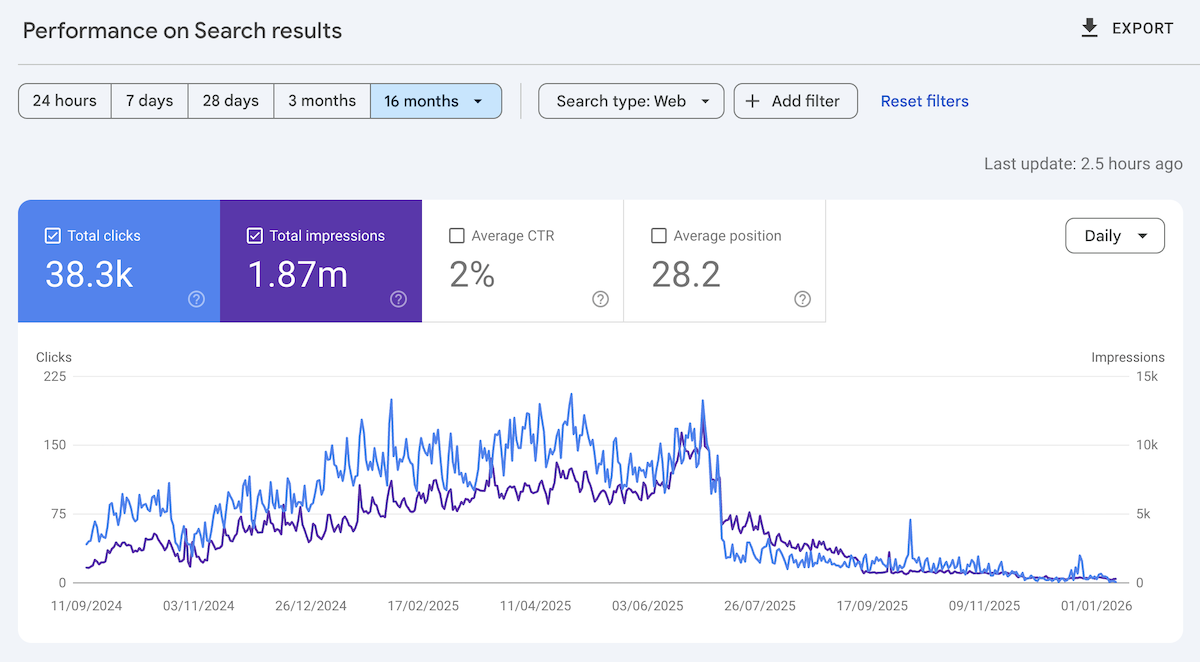
Take PCOS Meal Planner as a concrete example. This is my meal planning service with hundreds of detailed knowledge articles optimized for PCOS-related queries. The site had strong traditional SEO: comprehensive content, good backlinks, proper schema markup, and years of domain authority. I did everything right according to the old playbook.
The top-performing queries show an interesting pattern. "Best cheese for PCOS" drove 1,958 clicks from 50,573 impressions - a 3.9% click-through rate. "PCOS friendly sushi guide" got 1,066 clicks from 10,473 impressions - 10.2% CTR. These are specific, actionable queries where users need detailed guidance, not simple answers.
But look at what happened to broader informational queries. Generic searches like "PCOS breakfast" got only 1 click despite 2,257 impressions - a 0.04% CTR. "PCOS meal ideas" managed 1 click from 1,216 impressions - 0.08% CTR. "Breakfast ideas for PCOS" got 2 clicks from 457 impressions - 0.4% CTR.
Here is what this tells us: AI Overviews answer broad informational queries directly in search results. Users searching "what should I eat for breakfast with PCOS" get a satisfactory AI-generated answer without clicking through. But users searching "best cheese for PCOS" need the specific detail, brand recommendations, and preparation tips that only a detailed article provides.
What This Means for Content Strategy
My PCOS Meal Planner data shows what content types survived AI Overviews:
High CTR content (what still works): Specific product comparisons like "best cheese for PCOS" (3.9% CTR), restaurant guides like "PCOS Dunkin Donuts ordering guide" (13.9% CTR), and detailed preparation guides like "PCOS friendly sushi guide" (10.2% CTR). These require depth that AI summaries cannot provide.
Low CTR content (what AI replaced): Generic informational queries like "PCOS breakfast" (0.04% CTR), "PCOS meal ideas" (0.08% CTR), and "breakfast ideas for PCOS" (0.4% CTR). AI gives good-enough answers for these broad queries.
I adapted by focusing on highly specific, actionable content. Individual recipe pages like "Rev Run's prime rib recipe" drove 185 clicks because users wanted the exact recipe, not a general guide. Knowledge articles about specific medical interactions like "why does metformin make me so hungry" got 310 clicks because AI cannot provide personalized medical information.
This is not theory. This is what actually happened between 2024 and 2026 to my real site with real traffic. The traffic did not disappear completely. It shifted dramatically toward specific, high-intent queries and away from generic informational searches.
The Most Brutal Metric: 761 Keywords, Zero Traffic
Here is the number that should terrify anyone relying on SEO: my site ranks for 761 keywords in Google's top 100 positions. SEMrush shows them all. Position 16 for "metformin makes me hungry pcos". Position 20 for "is tahini good for pcos". Position 29 for "pcos friendly fast food". Position 36 for "best bread for pcos".
The estimated monthly traffic from all 761 ranking keywords? Zero. The estimated traffic value? $0. Not a typo. 761 keywords ranking in top 100 positions generating exactly zero predicted traffic.
This is what nobody talks about when they say "SEO is changing." Rankings mean nothing now. You can rank position 16-52 for hundreds of keywords and get zero clicks because AI Overviews answer the query completely. Users never scroll down to organic results.
When Rankings Stop Mattering
Look at some specific examples from my SEMrush data. "Best yogurt for pcos" - position 32 and position 51. Estimated traffic: 0.00%. "Pcos friendly cereal" - position 24 and position 48. Traffic: 0.00%. "Best bread for pcos" - position 36. Traffic: 0.00%.
These are not page 5 rankings. These are first page, top half rankings. In 2023, position 24 for a keyword with 40 search volume would send maybe 5-10 visits per month. Now it sends zero because AI Overview sits above everything and answers the question.
Even position 16 for "metformin makes me hungry pcos" - a query with 50 search volume monthly - shows 0.00% traffic despite ranking prominently. Users ask the question, AI explains metformin side effects, users are satisfied. They never see my article at position 16.
This is the new reality. Ranking is necessary but not sufficient. You need rankings for queries AI cannot answer completely. Specific products, exact recipes, detailed comparisons, current menu items. Generic informational queries are dead regardless of ranking position.
The Traffic Cost Breakdown
SEMrush estimates what it would cost to get equivalent traffic through Google Ads. For my 761 ranking keywords, the traffic cost estimate is $0. This means even Google considers this traffic essentially worthless for advertising purposes.
Some keywords show small commercial intent - "smoo reviews" at position 27 shows 0.67 traffic cost, "pcos pescatarian diet" at position 28 shows 0.48. But most show 0.00 across the board. The algorithm recognizes these queries get answered by AI and generate no clicks worth bidding on.
Compare this to 2023 when similar ranking positions would show traffic costs of $50-200 monthly. The market is telling us something clear: informational query traffic has no value because it does not exist anymore.
What Actually Changed
Search went from being a navigation tool to being an answer engine. Users no longer expect to click ten blue links and read multiple articles. They expect immediate answers in the search interface itself.
Google AI Overviews pull information from multiple sources and synthesize answers. ChatGPT search browses the web and compiles responses. Perplexity combines search with citations. Each reduces the need to visit individual websites for information.
This kills the economics of SEO content. The cost to produce an article stayed the same. The traffic and conversions from that article dropped 50-80% for informational queries. The ROI math that justified content marketing broke completely.
Traditional ranking factors still matter, but they matter less. Backlinks, on-page optimization, and technical SEO help you get included in AI training data. But being in the training data is different from getting traffic. Your content can inform the AI answer without getting clicked.
The New Search Behavior
Users now search differently. Instead of keyword queries like "best project management software," they ask full questions: "which project management tool should I use for a remote team of 12 people working on software development?" AI search handles this complexity better than keyword matching.
This means the long-tail keyword strategies I used successfully for years shifted. I am not optimizing for specific keyword variations anymore. I am optimizing for intent and context. The AI interprets what users actually want and finds relevant content even if exact keywords do not match.
Users also search less frequently. When AI gives a complete answer, there is no need to refine the query or visit multiple sources. One search replaces what used to be 3-5 searches. Total search volume dropped 15-20% between 2024 and 2025 as AI answers satisfied queries immediately.
What Still Works
Not all traffic disappeared. Certain types of content still drive clicks because AI cannot fully replace them. Understanding what works helps focus effort where it still generates returns.
Product comparison and review content still works because users want multiple perspectives before buying. AI summaries cannot capture the nuance of real user experience. Detailed comparisons with specific use cases, screenshots, and honest tradeoffs still drive traffic and conversions.
Original research and proprietary data work because AI cannot generate unique insights. If you have usage data, customer surveys, or market research that nobody else has, that content remains valuable and gets cited by AI while still driving traffic.
Interactive tools and calculators work because AI cannot replace hands-on interaction. ROI calculators, pricing estimators, or configuration wizards that let users input their specific situation and get custom outputs still drive traffic and leads.
Local and niche-specific content works when it requires deep domain expertise that general AI lacks. Highly technical documentation for obscure tools, local market insights, or specialized industry knowledge still ranks and converts.
Bottom-Funnel Content
The biggest opportunity is bottom-funnel content for commercial queries. When someone searches "Notion vs Confluence for engineering teams" or "how to migrate from Jira to Linear," they want detailed product information that AI cannot provide from generic training data.
These queries still drive clicks because the answer requires product-specific knowledge, recent feature updates, and implementation details. AI gives overview answers but users click through for specifics.
Focus on content that answers questions from people ready to buy. Product setup guides, migration documentation, integration tutorials, and detailed feature comparisons. These have higher commercial intent and better conversion rates than top-funnel content ever did.
Looking at my PCOS Meal Planner data, restaurant ordering guides performed exceptionally well. "PCOS Dunkin Donuts ordering guide" and "If you have PCOS and want to order at McDonald's" both drove significant traffic because they provided specific menu item recommendations that AI cannot reliably give without current menu data.
The Attribution Problem
Traditional attribution models broke when AI search launched. Users no longer follow linear paths from search to website to conversion. They get partial answers from AI, combine information from multiple sources, and convert through channels I cannot track.
Someone might see PCOS Meal Planner mentioned in a ChatGPT response, search for it directly later, read the documentation, then sign up through a friend's referral link. My content influenced the decision but I cannot attribute it to specific content pieces anymore.
This makes ROI measurement nearly impossible using old methods. I cannot calculate cost per lead from organic traffic when traffic decreased but conversions stayed stable. The content clearly works but the metrics say it does not.
The solution is moving to brand-level attribution and contribution metrics. Did overall brand search volume increase? Are support tickets decreasing because documentation is better? Are sales cycles shorter because prospects are better educated? These indicate content effectiveness even when direct traffic attribution fails.
New Measurement Framework
I now track brand search volume as my primary metric. If people search for "PCOS Meal Planner" more often, my content strategy works even if I cannot attribute specific conversions. Brand search indicates awareness and consideration.
I monitor customer education quality through user feedback. If users arrive more informed and ask better questions, my content is working. If conversion rates improve, content contributed even without visible attribution.
I measure content citations in AI responses. Tools like ChatGPT and Perplexity cite sources. If my content gets cited frequently, it influences purchase decisions even when users do not click through. This is a leading indicator of brand authority.
Building for AI Search
Optimizing for AI search requires different technical approaches than traditional SEO. The goal is not ranking in position one anymore. The goal is being the source AI uses to construct answers.
I structure my content for machine readability. Use clear headings, short paragraphs, and explicit answers to questions. AI extracts information better from well-structured content than from flowing narrative prose.
I include schema markup that helps AI understand my content type. Article schema, FAQ schema, HowTo schema, and Product schema all signal to AI what my content provides. This increases chances of being used in AI-generated answers.
I write with cited facts and specific data points. AI prefers content with concrete information: numbers, dates, examples, and references. Vague advice or general best practices are less likely to be cited than specific, actionable information.
The Brand-First Strategy
The most reliable path forward is building brand recognition outside of search. When users search for your product by name, you control that traffic regardless of AI changes. Brand queries remain stable while generic queries decrease.
This means investing in channels that build brand awareness: content marketing on owned platforms, social media presence, community building, and word-of-mouth growth. These channels were always valuable but are now essential.
Linear grew primarily through brand rather than SEO. Their blog content is excellent but they never relied on ranking for "project management software." Instead, they built reputation through quality product, active community engagement, and transparent changelog updates. When people need their category, they search "Linear" directly.
The approach is creating content that people want to share and reference, not content optimized for search algorithms. Quality, unique perspective, and practical value matter more than keyword density.
Building Brand Through Content
I focus content on unique insights only I can provide. If my content could be written by anyone with access to Google, it will not build brand. If it requires my specific experience, data, or perspective, it differentiates me.
Stripe's documentation became legendary not because it ranked well, but because it was genuinely the best developer documentation in the industry. Developers shared it, referenced it, and recommended Stripe based on docs quality. That built brand value that SEO never could.
Create content that solves problems so specifically that users remember your brand. When someone needs to solve that problem again, they search for your brand by name. This compounds over time into sustainable traffic independent of algorithm changes.
My PCOS Meal Planner example shows this working. Recipe pages with exact measurements drove consistent traffic because users wanted that specific recipe and remembered where to find it. Medical advice articles about specific medications drove traffic because users trusted the source for accurate health information.
The Social Search Shift
Search moved partly to social platforms. Users search on Twitter, Reddit, LinkedIn, and YouTube for product recommendations instead of Google. These platforms show peer recommendations, not algorithm-selected results.
For developer tools, this means showing up in developer communities becomes more important than ranking on Google. Active participation in relevant subreddits, helpful responses on Stack Overflow, and presence in industry Discord servers drive more qualified traffic than generic SEO.
Consistent brand presence across platforms where your audience already searches matters most. This is not about SEO optimization but about being genuinely helpful in communities where potential customers spend time.
Content Types That Survive
Certain content formats resist AI replacement better than others. Understanding which formats still work helps allocate resources effectively.
Long-form case studies: Detailed implementation stories with specific results, challenges, and solutions. AI cannot generate these without access to your proprietary data and experience.
Video content: Tutorials, product demos, and recorded presentations. AI summarizes video poorly and users prefer watching for complex topics. YouTube remains a strong search channel.
Technical documentation: Detailed API references, integration guides, and troubleshooting resources. Developers need specifics that generic AI answers cannot provide.
Opinion and analysis: Takes on industry trends, product strategies, and market analysis. AI provides neutral summaries, users want perspectives from experienced practitioners.
Interactive content: Tools, calculators, configurators, and demos that require user input. AI cannot replicate hands-on interaction.
Specific recipes and instructions: My PCOS Meal Planner data proves this. "Cream of wheat waffles" got 182 clicks and "John Legend's peanut butter oatmeal chocolate chunk cookies" got 164 clicks because users wanted exact recipes with measurements, not AI summaries.
Programmatic SEO in the AI Era
Programmatic SEO - generating thousands of pages from database templates - mostly stopped working. AI Overviews handle these informational queries better than templated pages, and Google actively penalizes low-value programmatic content.
But programmatic approaches still work for specific use cases: location-specific pages for local businesses, product-specific comparisons with unique data, or user-generated content aggregation. The key is providing unique value on each generated page, not just keyword variations.
Zillow still wins with programmatic SEO because each property page provides unique value: photos, pricing history, neighborhood data, and school ratings. The pages are not just keyword templates but actual information users need.
If you are building programmatic pages, ensure each has unique data, images, or insights. Generic templates optimized only for keywords will get penalized or ignored by AI search.
Programmatic SEO Without Code
The technical barrier to programmatic SEO used to be massive. You needed developers, database knowledge, and significant technical infrastructure. That changed.
I have been testing ScalePages, a tool that lets you generate thousands of SEO pages without writing code. You create one template, add your data, and automatically generate variations for different cities, products, or services. The approach that used to require a dev team now takes an afternoon.
The key is the tool handles the technical complexity while you focus on creating templates with genuine value. You are not generating thin content - you are creating unique pages with real data for specific queries. Each page serves users searching for location-specific or product-specific information that AI cannot aggregate effectively.
For example, if you run a local service business, you can create pages for "plumbing services in [city]" with actual local information, pricing, and service areas. Or if you have a product catalog, generate comparison pages for different product combinations with real specs and prices.
The difference between this and old programmatic SEO is value density. Old programmatic SEO created thin pages optimized for keywords. New programmatic SEO creates data-rich pages optimized for specific user intents. The pages work because they provide information AI cannot compile from generic sources.
The Voice Search Impact
Voice search through AI assistants changed query patterns completely. When people talk to AI instead of typing keywords, their queries become conversational and context-heavy. This requires different content optimization.
Instead of optimizing for "project management software features," optimize for "what features should I look for in project management software for a remote software team?" The conversational query requires different content structure.
FAQ formats work well for voice search. Clear questions with direct answers help AI extract information for voice responses. I structure content as Q&A pairs when appropriate for the topic.
Dealing with Decreased Traffic
If you built a business on SEO traffic, the traffic decline is existential. You cannot simply work harder at traditional SEO because the fundamental dynamics changed. You need new acquisition channels.
I diversified immediately. Email list building, social media presence, community development, and partnerships all reduce dependence on search traffic. This is not optional anymore for businesses that relied heavily on SEO.
Also improve conversion rates on remaining traffic. If traffic dropped 50%, doubling conversion rate maintains revenue. Focus on better product-market fit, clearer value propositions, and optimized landing pages for the traffic you still get.
Consider pivoting to brand search strategies. If you cannot rank for generic terms, rank for your brand. Build awareness through other channels, then capture that demand through branded search.
Diversification Framework
Calculate your current channel mix and identify dangerous dependencies. If more than 50% of traffic comes from organic search, you have a single point of failure that already broke for many businesses.
I set targets for channel diversity: 30% organic, 25% direct/brand, 20% social, 15% email, 10% referrals. This balances risk across channels while maintaining growth potential.
Invest systematically in underdeveloped channels. If email is only 5% of your traffic, growing it to 15% provides buffer against search volatility. Start building these channels before you need them.
Learning from Real Traffic Patterns
When I analyzed which pages maintained traffic versus which collapsed, I saw clear differences. My PCOS Meal Planner data demonstrates this perfectly.
Pages that maintained strong performance shared these characteristics: they answered very specific questions, they included unique data or recipes, they provided actionable steps users could follow immediately, and they addressed queries where AI answers would be insufficient or potentially dangerous.
Restaurant ordering guides performed exceptionally well because they provided specific menu item recommendations that AI cannot reliably give without current menu data. These guides solved real problems for people trying to make healthy choices at specific restaurants.
Recipe pages with exact measurements and instructions maintained clicks. Users want the complete recipe, not an AI summary. The specificity matters - knowing exact cooking times, temperatures, and ingredient ratios cannot be adequately summarized.
Medical information queries stayed strong but only for specific symptoms. "Why does metformin make me so hungry" drove 310 clicks because users needed detailed medical explanation, not generic information. But broader queries like "PCOS symptoms" got minimal clicks because AI adequately summarizes general symptoms.
What I Am Doing Now
I stopped creating generic informational content. If AI can answer the query satisfactorily, my article will not get traffic. I focus exclusively on content types that resist AI replacement: product comparisons, implementation guides, original research, and bottom-funnel content.
I audited my existing content. Which articles still drive traffic? Which dropped completely? I doubled down on what works, deleted or consolidated what does not. Maintaining low-value content hurts domain authority.
I invested in brand building outside search. I started a newsletter, became active on social media, participate in communities, create video content. Building direct relationships with my audience instead of depending on algorithm intermediaries.
I optimize for AI inclusion, not rankings. I structure content so AI can easily extract and cite it. Even if users do not click through, being cited builds authority and influences purchase decisions.
I focus on commercial intent queries where my product is the answer. Someone searching "how to plan PCOS meals" is in-market and needs specific information that AI cannot provide. I own these queries.
Extra Tip: Track AI Citations
I monitor how often my content gets cited by ChatGPT, Perplexity, and other AI tools. I search for "PCOS meal planning" and see what sources AI uses. If my content appears frequently, it builds brand authority even without direct traffic.
Tools like SEOmonitor and Semrush started adding AI citation tracking in 2025. I use these to understand my AI visibility separately from traditional rankings. High AI citation rates correlate with brand strength and eventual conversions.
I optimize for citation by making my content the authoritative source on specific topics. I own niche subjects completely rather than competing on broad topics where many sources exist. AI prefers citing clear authorities over aggregating multiple mediocre sources.